Tuesday, April 3, 2012
LAUREN LEVY makes Intricate Sculptures
out of Wire & Buttons & Fabric & Generally Brings
Uncommon Beauty to Life's Enriched Pageant
The first time I saw Lauren Levy's work, it was part of a group show at D Berman Gallery back in 2001. I don’t recall what else was in the show ~ and there must have been much good stuff ~ but those objects, those small dresses and houses built from layer after layer of colorful buttons and wire, have never left my mind.
In 2001, I was still married to the playwright Molly Rice ~ which I mention because she was with me at the show and she’s got fierce aesthetic sensibilities ~ and she was also stunned by Levy’s work. We looked at the sculptures, then looked at each other, and our thoughts were somewhere along the lines of: “Wow, these buttony creations are as deeply evocative as they are well-crafted and visually beautiful; this is important work by an accomplished artist.”
Well, accomplished, certainly.
But by no means, contrary to what we’d assumed, established.
“I was part of a group show at Women & Their Work in 2000,” says Levy. “I just applied. The woman who worked there as the assistant director encouraged me, and I think she was largely responsible for me getting in. So I was in this show, and it was like the biggest thing in my life. And David Berman immediately asked me, because it was also the first night for his gallery, and he called me the next day and asked if I wanted to be in his gallery. And I said, uh, I don’t know from galleries. And he said, well, neither do I. And it was perfect, we just kind of went along together.”
This was followed, over the years, by more shows at D Berman, and several shows ~ alone or as part of a group ~ in other Texas venues. Culminating, at least buttonwise, in the 2009 “Beneath the Palm of My Hand” solo show at D Berman, in which Levy’s sculptural work morphed from 3-D into more 2-D arrangements of buttons on fields and lengths of fabric: No less intricate or compelling than those dresses, those houses, those horns.
But also, rather suddenly, uh-oh, 86 the buttons.
“I got sick of doing buttons,” says Levy. “People called me The Button Lady, and I hate that. It sounds so kountry-krafty, so hot-gluey. I don’t like it when people can’t see beyond the material.”
Brenner: Well, sure. But, hold on ~ how’d you get started with buttons in the first place?
Levy: I went to art school at UT in the late 80s, and I had absolutely nothing to say. It was a time, generally, where all the painting was more or less abstract. The figure hadn’t really come back into artwork yet, so the painting at school was abstract, the art ~ not all of it, but a lot of it ~ was very conceptual. And being kind of a process-oriented person, I couldn’t connect with anything that was going on there. At the time there was this big difference between craft and art. And, y’know, I was a cool person, I didn’t really want to be associated with the pot-makers and the turquoise-ring-makers, so I went into nursing school almost as soon as I graduated. And then, when I was in Portland, I found my voice doing metalsmithing. I was making not so much jewelry as small objects, and I just became possessed by it. I finally felt like I Have Something To Say, and it was just electrifying.
And when I came back to Austin, I was seven months pregnant and it was a really depressing time. Because I was just burning up inside with stuff to say and things to make, but when you have a baby, you’re kind of in prison. I’d had real unreasonable expectations of what babies were like: I figured they just slept all the time. But, no, they don’t.
And I was an avid knitter at the time, and I’d collected all these buttons. And I guess I started with wire ~ wire that didn’t need to be soldered, that I could just bend it all around and make what I wanted. And somehow I got the idea of stacking the buttons up one by one, as an equivalent to stitches … so I started making little articles of clothing out of wire and buttons, in lieu of the knitted things I was making.
Brenner: What fascinates me is that a million people could do that,
but what they did would look like crap.
Levy: Really?
Brenner: I don’t know about wire and buttons, specifically, but when people take typical crafting materials, they tend to do stuff that looks like, if not crap, then like what somebody’s non-artistic grandma did when she had spare time between issues of Reader’s Digest. Kitschy craft or crafty kitsch, or whatever. But then somebody, one in a million or whatever it is ~ you, in this case ~ can use the same sort of materials, and it results in, well, it looks like some of the finest art there is.
Levy: It’s a fine line sometimes, isn’t it?
Brenner: Well, I’d say that it’s more obvious sometimes, that ~
Levy: Well, not about myself so much, but, yeah, I guess you can immediately tell ~ like with abstract painting, for example. Everybody looks at it, like at a Franz Kline, and a lot of people would think “What’s the point? My kid could paint that.” But it’s really the most difficult, thoughtful, not-process-oriented painting.
Brenner: So you started out by using buttons to make these articles of clothing, dresses and shirts. How did that transform over time?
Levy: Now that I think about it, they kind of transformed from the inside out. They were shirts, and then I started filling them with things, to express something else, and then the thing that was being expressed through the garments was the thing that I was making.
So the shirts and dresses started disappearing and the narrative dropped away. There came an end to the stories ~ I wasn’t really interested in the stories anymore. And that was kind of a weird moment, when the narrative fell away and I just started making things and then the story would come. It was so exciting to make something without trying to define it, to just give in to the original impulse ~ make it ~ and then it became obvious that of course there was a story there.
So narrative became secondary. And I guess that’s the immediate starting point of how I ended up making the stuff I’m making now.
Brenner: And for a while you completely stopped using buttons?
Levy: Yeah, I packed all the buttons up, stuck them in my various storerooms, cleaned them out of my studio altogether. I had to leave myself open to the possibility that that was done. Because I wanted to start over, to go back to making art in a thrashing-around, searching way. To allow myself to be bad. It was nice to be bad. To make stuff that kind of sucked. But then I’d make stuff out of non-button materials … and I didn’t like any of it. It was depressing.
Brenner: And is that where the drawings came from, those back-of-the-head braids?
Don’t tell me you just recently picked up a pencil for the first time and ...?
Levy: Well, it seems like, when I was really young, I was that person in class where somebody was always saying, “Draw this for me, draw that for me,” y’know? And somewhere along the way, like most people, I decided I Can’t Draw. Like, I just couldn’t do it.
So I quit drawing altogether. I didn’t draw in high school, and I especially didn’t draw in college ~ I didn’t take drawing, even though I got an art degree. Because I was so petrified of it. And I decided, at some point, that I was a fraud. Like, “I’ve been hiding this deficit, this inability from the world.” So I decided that I would take a year off and just draw.
This was around the end of 2006, right after that D Berman show. I was kind of burned out ~ putting that show together took a lot of time. And I wanted to give myself the opportunity to have one of those exciting kind of moments where you realize “This is it: This is where I take off, and now I look for the boundaries within this.” And I drew all the time, I drew and drew and drew. And I read, and I looked at drawings. I’d get stacks of books on drawing and I’d stare at drawings. And I got really educated about drawing in general. And nothing ever came of it, really, although I have suitcases full of drawings.
And then I was walking my dogs in the neighborhood, and it was Big Garbage Day. And I walked by a house where this person had just put something out. And it was an old 19th century box, like a shipping box from some sort of military suppliers, and in it was this family’s photographic history going all the way back, from the 1800s, from the first era of studio photographers, going up to the 1960s, and it was stuffed full of these photographs. And there were several other boxes and suitcases, and I had all four of my dogs. And one dog is terrified, and one dog hates the other dog, and one dog is like “Let’s go! Let’s go! Let’s go!”
So I was standing in the middle of the street with all these dogs, and somebody came up and helped me out and took the stuff home. I still haven’t gone all the way through it. But what I did look at, there were these really candid photographs that were obviously family members of the photographer, because they were very animated, not at all like the photographs he took in his studio: They were really spontaneous.
And one of them was the back of this woman’s hair, with this elaborate Victorian hairdo. And I went, “This is what I’m gonna draw.” And I drew it in ink, and in pencil, and the hairdo kept getting bigger and bigger, up to the point where the person wasn’t in the drawing at all. Then it became just a big ball of hair.
And I was posting the drawings on Facebook, when I was first getting into Facebook and reconnecting with people. And I had this sense of time, like how, even though some of these people and I had nothing in common, we had this connection that had lasted through all this time. And so the drawings, the hair, became a kind of metaphor for time. Well, not even a metaphor, it kind of ~ it is time. Isn’t it? Can you say that?
Brenner: Well, it’s ~ as much time as anything else is.
Levy: Well, it embodies time. So that’s what these pieces are: Time and work. And so I’d started drawing again, and I’d made myself ready for the impulse, for whenever it would come. And when I found what I wanted to draw, the skills were there. And I looked back at all my older drawings, and they’re obviously like student work ~ but it’s nice to see the struggle.
And what I’d regarded as a lack of drawing talent … well, talent’s overrated, really. It’s just work. If you work at something, and it may take a lot of work, yeah, but even people with talent really have to work at it. Because, if you don’t, it just goes to waste. So I worked hard, and in the end I made drawings that I liked, that I felt were more than the sum of their parts.
Brenner: But you’ve also gone back to using buttons again?
Levy: As I was doing those drawings, I realized “This is where the sculptures are going.” So I started making long vertical pieces ~ like long twisted braids made with buttons ~ and I love them. The ones I’m making now, it’s really strange: I’ll get a piece of cable ~ industrial, galvanized cable ~ and pull it out, cut it when it feels like the absolutely perfect length, and they’re always as tall as me. They’re always my exact height. Isn’t that weird?
Brenner: That’s kinda weird.
Levy: It’s really weird. It happens every single time, and I’m not even pulling the cable out vertically. But I’m gonna do them even bigger, gigantic, and they’re not going to rust. That was the thing about the wire ~ it rusted and drove me crazy.
But, yeah, here I am again, using buttons, and I know I’m running the risk of being The Button Lady, but, y’know, that’s just where it is. And there are drawings to go with it, too, these really obsessive, process-oriented drawings. So I’m back to time-consuming, obsessive-compulsive kind of stuff.
Brenner: Obsessive-compulsive ~ or maybe just really giving a damn
about what you’re doing.
Levy: Yeah, maybe.
Brenner: You don’t think so?
Levy: Well, I don’t know.
Brenner: Is it a thing that, when you do it, you feel like you’ve finally scratched an itch?
Levy: Kind of … but it’s also nice to go on automatic, you know? Which is something that knitting taught me, through the process of just doing something over and over and over.
I can remember one time when I was in metal-smithing class, and I made something that was really time-consuming, and I went, “Oh, I’ll never do that again.” And the woman I was taking the class from said: “Why? Make a ton of them.”
And I realized, yeah, that’s just kind of what you do.
Monday, April 2, 2012
FORGET MAKING YOUR BED
by Abe Louise Young
(for Emily Joan)
Forget making your bed. Make your desk instead.
Let your bed sheets lie rumpled on the floor
with pillows underneath them
like elephants in the bellies of snakes,
with stuffed animals and a water glass
tipped over on top.
Forget the bed. Put the pages of your desk in order.
Line up the sheets from head to foot.
Smack the dust and grit off. Shelve the books.
Make your bet that what you’ve got to write might crack a boulder
like a light bulb, that a cone of butterflies will stream out,
that you could make a person you’ve never met
want to give birth through her eye sockets.
See those piles of old textbooks,
post-it notes, envelopes
with little plastic windows, job application folders,
nests of screws and nails and grommets,
empty condom packets, coupons for bulk soy milk?
Take it all and throw it out.
Would you sleep in that?
No.
Dream at your desk, then work your mind
through its torque. Mime the regular simplicity
of milking a goat. Every day, twice.
Morning and night.
A squirt of hot goat’s milk
puddles in a metal pail with each gentle tweak
of your mind’s nipples.
If you don’t, the goat will cry.
Have you seen mastitis?
So milk the stream down, thin as silky thread.
Stir the cream slowly so it turns to butter,
then heat it to cheese,
add those herbs you’ve spent years growing
in cracked pots on the windowsill.
Memory sits down gratefully
like an old farmer
and takes off its weathered, sweaty cap.
Out of the sun, off the fields,
in your company. Put out a loaf of bread.
Put your head where your feet should be.
Hug the pillows to your chest.
Pretend you hold a body, soft, trusting,
someone who’s not going to leave at morning light.
These are your readers,
the ones you need, the ones you are lonely,
brittle, adrift without, the other mammals
full of feathers, like you,
who miss their mothers, like you,
are ringed round with zippers, like you,
indented and passive, like you. But not tonight.
The night is big and empty on your desk.
Touch blank paper with your fingertips.
The paper used to be trees; seed,
soil, water and sun, which used to be
your ancestors’ voices and breath
buried in light without a box.
They will lead you to your readers.
You might never know them,
you might die before they’re born.
But tonight, hold them tight.
Make the desk sprout leaves and sing.
Make it feel like a sapling.
(for Emily Joan)
Forget making your bed. Make your desk instead.
Let your bed sheets lie rumpled on the floor
with pillows underneath them
like elephants in the bellies of snakes,
with stuffed animals and a water glass
tipped over on top.
Forget the bed. Put the pages of your desk in order.
Line up the sheets from head to foot.
Smack the dust and grit off. Shelve the books.
Make your bet that what you’ve got to write might crack a boulder
like a light bulb, that a cone of butterflies will stream out,
that you could make a person you’ve never met
want to give birth through her eye sockets.
See those piles of old textbooks,
post-it notes, envelopes
with little plastic windows, job application folders,
nests of screws and nails and grommets,
empty condom packets, coupons for bulk soy milk?
Take it all and throw it out.
Would you sleep in that?
No.
Dream at your desk, then work your mind
through its torque. Mime the regular simplicity
of milking a goat. Every day, twice.
Morning and night.
A squirt of hot goat’s milk
puddles in a metal pail with each gentle tweak
of your mind’s nipples.
If you don’t, the goat will cry.
Have you seen mastitis?
So milk the stream down, thin as silky thread.
Stir the cream slowly so it turns to butter,
then heat it to cheese,
add those herbs you’ve spent years growing
in cracked pots on the windowsill.
Memory sits down gratefully
like an old farmer
and takes off its weathered, sweaty cap.
Out of the sun, off the fields,
in your company. Put out a loaf of bread.
Put your head where your feet should be.
Hug the pillows to your chest.
Pretend you hold a body, soft, trusting,
someone who’s not going to leave at morning light.
These are your readers,
the ones you need, the ones you are lonely,
brittle, adrift without, the other mammals
full of feathers, like you,
who miss their mothers, like you,
are ringed round with zippers, like you,
indented and passive, like you. But not tonight.
The night is big and empty on your desk.
Touch blank paper with your fingertips.
The paper used to be trees; seed,
soil, water and sun, which used to be
your ancestors’ voices and breath
buried in light without a box.
They will lead you to your readers.
You might never know them,
you might die before they’re born.
But tonight, hold them tight.
Make the desk sprout leaves and sing.
Make it feel like a sapling.
Saturday, March 31, 2012
NOISE POP'S COVERS:
Songs in the Key of Food
In a single week, near the beginning of the month just passed,
I had two of the most amazing dining experiences of my life.
But I'm going to mention the first one only in this paragraph, by way of a tip-o-the-hat to artist Jeff Scott and the Austin Chronicle's food editor Virginia Wood and the fine folks at Foreign & Domestic who feted our fortunate table with one of almost everything from that night's diverse menu.
But I'll return to Scott and F&D in these pages again, to be sure.
I'm also hoping to return to whatever next thing the tastemaking music-and-food impresarios of San Francisco's Noise Pop and graffEats projects do locally.
Because that's the other dining experience that recently dazzled my sensorium.
To the point where I actually write things like "dazzled my sensorium" with a straight face.
Listen: Noise Pop has this series they've been doing for years in California's Bay Area. It's called "Covers," and it's where graffEats chef Blair Warsham composes a multi-course meal based on the signature dishes of acclaimed chefs from around the nation.
Like covering a song, see?
Like how the Dum Dum Girls covered Morrissey's "There Is a Light that Never Goes Out," kind of, except that of course it's the tastes and textures, the whole culinary gestalt, of food that's being covered here.
Sound good?
Well, what sounds even better ~ literally ~ is that the whole glorious meal is accompanied by musical covers chosen to complement each course. Not just obvious choices based on wordplay ~ not somebody covering Chubby Checker's "Peppermint Twist" if there's a peppermint twist, say ~ although your hosts might be that endearingly goofy every now & again ~ but more subtle pairings of eclectic sonic goodness with what you're eating.
Yeah, it does sound good, doesn't it?
And to that, add this: Wine pairings provided by Wente Vineyards
for each course, too, if you're so inclined.
Perhaps, at this point, you're considering salivating?
Perhaps, at this point, you're already considering attending the next "Covers" iteration?
Let's take a closer look at this most recent one, first;
this one that Noise Pop brought to Austin in time for SXSW
and which they unveiled at the Swoop House.
Yes: That's the place near East Seventh that's run by Stephen Shallcross
and the savants of 2 Dine 4 Catering.
Yes: That's the place that hosts those incredible Supper Friends dinners.
The sound designer and Foley artist Buzz Moran accompanied me on this gustatory adventure, because we're both into food, as the saying goes, and because we never really have a chance to sit down & just chat although we're often involved in the same or overlapping projects. Also, the man looks good in a suit. Tall, thin, well-groomed. Dapper, like. You want some snazzy arm candy that's male, you call for Buzz Moran.
OH, THAT BUZZ MORAN!
You call for Buzz Moran and you drive over to the Eastside and park at the curb bordering the small, tidy lawn that fronts the clean and modern lines of Swoop House, a building that sits as pretty as a tilt-shift photo there on Gonzales Street where the blocks of houses continue to struggle against relatively water-rich Austin's version of foliage and forest. You walk up to the front porch, pause to decide between the choice of a vodka-based or tequila-based cocktail to start things off, to delight your palate and moisten your epiglottis and lubricate the ensuing conversation. Tequila, of course: This is Texas, goddamnit, and your residence here (in what is arguably the only worthwhile big city in the entire state) was hardwon, and you'll be damned if you don't choose a drink that derives its potency from something like a cactus.
Never mind that the agave isn't even related to a cactus. The facts can go fuck themselves, because agave looks like a cactus, and there's a couple of agave plants right down the street you just drove on, and, anyway, Christ, this cocktail feels as good as it tastes, going down all cool and smooth, ice clinking against the glass as you enter the Swoop House and are greeted by Noise Pop's Dawson Ludwig, who kindly invited you to this fancy shindig in the first place.
Ludwig's tall and bearded and charming. The interior of the house is as crisp and clean as its outside, with enough natural wood and simple-yet-elegant appointments that it'd make your ligneophile wife swoon. There are three separate dining rooms to this Swoop structure, each room centered with a white-cloth-covered table, place settings casting a silver gleam along the edges of each table and surrounding the rustic metal lanterns glowing along the table's midsection.
Gotta win that Lotto thing, you tell yourself for what won't be the last time this night.
You wander outside now, you and Buzz, sipping your drinks, roaming the grounds around Swoop House, taking in the scenery, the bits of garden still extant and the wide flat areas covered with tarp and being prepared, you assume, for the next season's array of homegrown vegetables. You linger while passing a vintage, subtly finned and turquoise-colored station wagon, then stand at the far edge of the back yard, near a patch of what might be broccoli or might be kale but in any case is enormous and looks like it'd be delicious all stir-fried and served up with a little roasted garlic and balsamic vinegar.
"It's a circle," says Buzz, pointing at what lies between you and the house.
"The lawn's a goddam circle."
Yes: The back yard's single expanse of lawn is a perfectly circular expanse, held in check by a thin band of iron; you're halfway around the wide dirt path that surrounds this grassy circle; everything's all horticultured and lovely, the whole area outside the Swoop House is making you have those lottery thoughts again. Also, that station wagon in the gravelly drive. Is it turquoise, precisely, you wonder, finishing your cocktail … or is it the pale and liquid blue that's at the heart of every agave plant?
You munch a bit from the tiny foil bag of barbecue-flavored popcorn you were handed before you left the building. The spices on the popcorn are complex and intriguing. But the popcorn itself …
"This popcorn," says Buzz, chewing. "It's not really the freshest popcorn I've ever had. But the spices ~ oh, man. That's," he says, smiling, chewing, "that's some good stuff."
Yes: Doesn't the popcorn seem slightly … stale?
An amuse-bouche that's not so … amusing?
Mark that, make a note of it: You'll need to remember this mild disappointment: It will provide the only low point, the sole negative contrast, in an evening of wonders.
Which wonders await as you walk back past the agave-heart-blue Chevy wagon and navigate through the gathering celebrants to re-enter the Swoop House and find ~
Ah, but let's pause here for a moment; this blogpost is already so much longer than it's supposed to be.
Let's break it into two pieces, shall we? The way a pair of friends ~ a writer and a reader, say ~ might break a warm baguette into two shorter pieces for ease of sharing.
Maybe even pour yourself a glass of wine before clicking here to continue …
SHARING THE "COVERS"
Inside the Swoop House, the elegant tables are filled with excited diners. There are local people, folks in from beyond Texas to attend SXSW, all manner of foodies and media types.
We're sitting, we're waiting, we can smell a delicious aroma in the air.
(This post, this event, had a prelude.
We'll still be waiting, if you missed it & want to get the backstory first.)
Dawson Ludwig, standing nearby, calls for our attention, tells us what we can expect this night. Tells us about the history of the "Covers" events from Noise Pop and graffEats, about the musical covers chosen to complement this night's gourmet offerings, about the wines from Wente Vineyards that will be accompanying all of it. He smiles, raises a glass.
The diners raise theirs in response.
Huzzah! Slainte! Cheers! Prosit!
And so it begins.
Remember that each course will be a cover: GraffEats chef Blair Warsham recreating signature dishes from the country's top chefs.
Know that it starts local, with inspiration from the ATX's sushi wunderkind: The appetizer is from Uchi: Tyson Cole's Uchiveche Salmon (with striped bass, tomato, bell pepper, garlic, and cilantro). Perfectly presented, cold, sharp, melt-in-your-lucky-mouth bits of fish sending your tastebuds directly to paradise without the need for jihad or a life of deprivation. The accompanying music is "an interplay between Japanese and American culture." Yes, it is: Takeshi Terauchi covering the Beach Boys' "Surfer Girl;" the 5.6.7.8's doing the Ikettes' "I'm Blue;" The Knack's "My Sharona" covered by Saijo Hideki.
You're chewing, you're tasting, you're listening, you're looking at your date for the evening – Buzz Moran, seated next to you near the head of the main table – and he's smiling as big as you must be smiling. Hell, everyone's smiling ~ smiling and eating. The room is lousy with grins and the sounds of happy mastication.
Next up is what you're going to recall as the single best part of this superlative parade of food: Hot Potato/Cold Potato, a dish by Grant Achatz of Chicago's Alinea. It's a hot, like, potato kebab ~ like some kind of elongated indie Tater Tot on a wooden skewer. Damned tasty, with just enough crunch to the outside, and warm spicy goodness inside. But. What it's sitting in? The cold potato soup? What is this? How does a fucking tuber come out of the ground and wind up conjuring such sensual glory in a human mouth? Smooth, creamy, yadda yadda, those words mean nothing, those words are inadequate to describe … Oh, sweet gibbering Brillat-Savarin, what a dish!
You try to steady yourself in the present, grab hold of something concrete so you don't evaporate away to a gourmand's Nirvana. You try to remember the staleness of the evening's pre-prandial popcorn snack, but you can't do it. Nothing exists except the soup, this soup, this soup, oh my god.
Music: The xx, covering Aaliyah's "Hot Like Fire;" Marvin Gaye's "Sexual Healing" interpreted by Hot Chip; White Hinterland having a go at Justin Timberlake's "My Love."
Then there's a course of Fuji Apple Salad Kimchi (with smoked jowl and maple labne) from David Chang's Momofuku, and the combo of sweet and savory, of tart and smoky, almost has your teeth jockeying for position closest to the action. Munch, munch, munch. Yes, yes, yes.
Music: Amy Milan covering Death Cab For Cutie's "I Will Follow You Into the Dark;" Grizzly Bear's version of "He Hit Me" by The Crystals; and The Zombies' "Tell her No" modernized by Tennis.
[I should mention here that, all the while, our glasses are being filled with those Wente wines. Chardonnay, pinot noir, all that sort of thing, constantly being refreshed during and between courses, the waiters and hosts as attentive and generous as flight attendants in the first-class section of a British Airways flight to Saudi Arabia. I'm not a wine drinker, but Buzz (who is) seems pleased, and all around our table and in the other two rooms I see people sipping or swigging from that bounty of the grape, telling each other "Mmmm, hey" and "Oh yes, this will do" about what's in their hands.]
Which brings us to the Roasted Cauliflower (with grapes and almonds and curry) a la Daniel Humm of NYC's Eleven Madison Park. Why, it's like a weird mirror-image of that Fuji Apple plate and downright scrumptious, a fine herald to what (we see it on the little menus that have been provided each diner) comes next: The main course of meat.
Which, as the three different interpretations of Joy Division's "Love Will Tear Us Apart" ~ by Broken Social Scene and Nouvelle Vague and Calexico(!) ~ fade away, arrives:
Berber Spice Roasted Lamb Haunch, as interpreted in San Francisco's Aziza by Mourad Lahlou, with carrot marmalade, brown butter couscous, and harissa emulsion. Serge Jorge covering David Bowie's "Rebel Rebel" begins to play as we tuck into the lamb. Gotan Project's remix of "Whatever Lola Wants" (Nina Simone) segues in as we explore the plate further. By now the conversation in the room has reached a level where it's nearly drowning out the music, but you can still hear sounds of gustatory satisfaction rising from the (by now slightly tipsy) diners. The lamb, so tender and sharply spiced, its accompaniments, so righteously complementary … You look over at Buzz. He's chewing, he's raising his glass of wine in salutation; behind the lenses of his black horn-rims, his eyes are rolling back in his head with the pleasure of it all.
Amadou & Mariam's cover of "Hope" by Fat Freddy's Drop competes for attention above the diners' motley oratorio.
And now we're on to the dessert.
Everybody's gabbing at top volume. The sound system in the Swoop's coveted interior plays the White Stripes doing Dolly Parton's "Jolene," Nirvana reprising Bowie's "The Man Who Sold the World," and Jose Gonzales doing his thing with The Knife's "Heartbeats."
The dessert plates descend on polite hands. It's from Boris Portnoy's Meadowood venture in California. It's a Caramelized Brioche (with vanilla, citrus marmalade, tarragon, and crème fraîche). It's like a cross between French Toast and Crème Brûlée, is what it is. It's delicate and crunchy and … wow, you know? It's wow.
"Hey, uh," says Buzz to our affable chef who's walking around & checking to make sure all is as it should be. "Hey," says Buzz, "this … crème fraîche? There's ~ what is that? Is there salt right in it? I'm getting a salty taste – it's delicious, yeah! – but how … ?"
And Warsham describes the original recipe and his particular methods as we continue munching, as the last sweet bites vanish down our gullets, as glasses are drained and three tables of very satisfied guests prepare to call it a night.
A night of eclectic culinary and musical curation, of a gourmet anthology
from the talented professionals of Noise Pop and graffEats and Swoop House.
Thursday, March 29, 2012
MO DAVIAU:
On the Death of the Novel
THE AUTHOR HERSELF
It is good that I did not leave my home to learn about writing novels during wagon-train times. News of the novel's death would not have reached me until after I'd packed my few earthly belongings into my wagon and traveled to Michigan, knowing I would never see my friends back in Texas ever again. Upon my arrival, I would be told that the novel was dead, and after I was done weeping and cursing my very existence, I'd have to choose between prostitution or marrying the widowed butcher, who was looking for a strong-backed woman to take care of his bratty, bereaved children. He'd smell like raw meat when he'd lay me on the bed to do his business and I'd have to take up religion just so I could pray that he would kindly not beat me. Nowadays, at least I can fly home for the weekend for a visit, and if the novel is dead, we have the Internet to lament its demise. Or we can revive the novel. Blessed be the future!
~ Monique Daviau
Tuesday, March 27, 2012
Friday, May 27, 2011
Tuesday, May 17, 2011
Sequel Harangue for the Literary Farang
1. Right now I'm halfway through reading John Burdett's The Godfather of Kathmandu, the fourth in his series of vivid Bangkok-set crime novels featuring Detective Sonchai Jitpleecheep; I've already read the first three.
2. You know the whole thing about sequels, right? The conventional wisdom, whether it's regarding movies or books or whatever? How the sequel's never as good and possibly much worse? Well, check two cases in point:
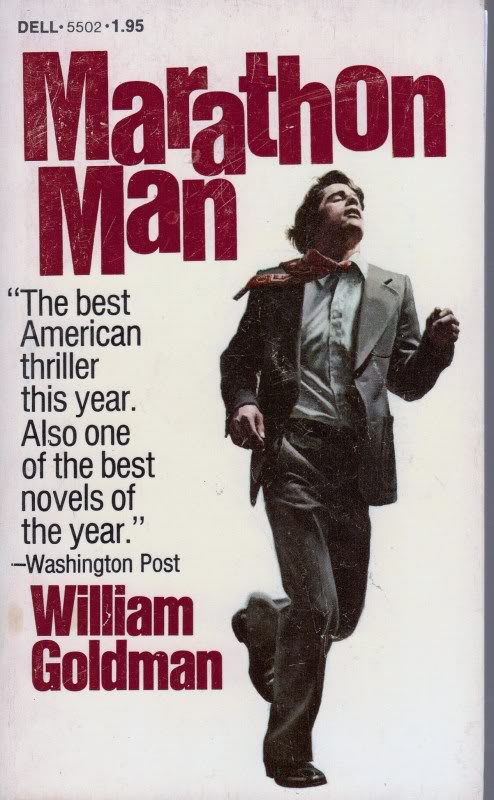
(1) William Goldman's 1974 novel Marathon Man was made into a terrific movie in 1976, but, as if amazingly, the original book was even better.
Remember? What a richly textured, character-thick narrative for all that it was a popcult thriller, right? What an excellent read.
But then there was the sequel, Brothers. Which was like Goldman revisiting those characters while he's goofing around on vacation somewhere and visiting upon those characters the mere framework of a farfetched plot in a story containing barely any of the textures and depths of the original.
A disappointment, to be sure.
(2) Same thing, IMHO, same damnable progression, same devolution following from Erica Jong's excellent 1973 bestseller Fear of Flying.
Well, sure, I completely skipped FoF's immediate sequel, How To Save Your Own Life. But, by the time Parachutes and Kisses, the third in the series about Isadora Wing, was available and I'd given it a try ... all I could do was give it was a try.
Again: It was as if the author had decided, Well, okay, I put enough work into the first novel, and never mind reveling in the depths of character, let's just streamline this one so it requires less effort for me to write and for the average reader to consume.
Sad, y'know?
[ Listen: If we wanted to read Teflon-coated Lite fiction, we'd already be doing that (we already do do that, occasionally) with the wide variety of options available and constantly renewed everywhere else. We don't need, from deeply capable writers, Lite scribblings that so many others can crank out. We need the heavier stuff that only they can provide. Stuff, say, in the diverse Atwood/Mieville/Mantel/Lethem-inhabited range between Harry Potter and Ulysses. Yes? ]
3. And so, sweet suffering Buddha, how weird to discover
what seems to be the opposite of the lame progression noted above.
John Burdette's Bangkok series was a delight from the get-go, the briskly paced police procedurals made more flavorful and exotic by their Thai setting and the engaging, near snarky philosophical musings of the half-Anglo protagonist, Det. Jitpleecheep. The novels weren't the most strictly nutritious literary meals around, sure, to wrack a metaphor; but neither were they merely Asian-flavored paperback potato chips. But now here's the fourth one halfway down my reader's judgmental gullet ... and damned if Burdett isn't reversing the sequel curse.
The Godfather of Kathmandu is both spatially thicker than its precursors and more deeply written than them, regardless that the thrill & mystery of the story remains undiluted (and is, I'd insist, enhanced) by the more complex textures of character and philosophy woven therein. I have no idea how it's going to end, and I don't really care: I'm caught up in the story around the plot, and in Jitpleecheep's ongoing, conflicted, journey-of-self megillah; and when the book's over, okay, where's the next one, please.
About that: Burdett's fifth in the series, Vulture Peak, is due out from Knopf in January 2012. I've already bugged the Austin Chronicle's books editor about letting me review it when it's available, as soon as the advance copies are released. Hell, yes.
4. What I haven't mentioned in this extended harangue is the urge ... the faint but incessant urge ... to write some sort of fanfic wherein Det. Jitpleecheep teams up with Henning Mankell's Kurt Wallander to solve an international series of murders stretching from Thailand to Sweden.
And I won't, goddamnit.
I won't mention that urge.
Wednesday, April 27, 2011
Lend Them Your Fears
Authors Nate Southard and Lee Thomas are the co-chairs of this year's World Horror Convention ~ unveiling itself (in other than stygian darkness) over four days in the urban paradise of Austin, Texas. I recently interviewed them for the Austin Chronicle ~ you can see that much longer transcript right here – and these are some of the highlights of our palaver at Quack's Bakery on 43rd:
Brenner: Why does someone go to a horror convention, much less
the World Horror Convention, in the first place?
Thomas: People can’t always talk about this stuff at work or with their families. A lot of times people just don’t get it. But you go to the con and suddenly it’s like you’ve got four hundred of your best friends sitting around talking about horror, y’know?
Southard: For a lot of us, it’s the one weekend a year where we can sort of function as a society, where we’re not all the quiet people standing in the corner wondering how to start a conversation. We can actually figure that out in this circle.
Thomas: The wallflowers become a weed species.
[Brenner makes a note: This Thomas guy, he's fierce with the soundbites.]
Brenner: So both of you guys write?
Southard and Thomas: Yes.
Brenner: And when did you get started on that? How old were you
when you thought, “Oooh, I’m gonna write some fuckin’ horror.”
Although, ah, you might not have phrased it quite like that.
Thomas: I was in third grade, but I don’t think that counts. I was basically breaking copyright on the universal classics. And I just wrote as a hobby. That’s what I did when my friends were playing video games or going out to the movies and whatnot. I didn’t even try to start publishing until about ten years ago.
Southard: Pretty much the same story for me, but I’d gone about it from a different angle. In middle school and high school, I always wanted to write comic books for a living. And through high school and college, that morphed into wanting to be a screenwriter. And I came down here and went to RTF at UT. Very odd, getting a screenwriting degree from a documentary school. But, by the time I graduated, mostly by reading and picking up on some authors that I hadn’t really heard of before, I found this new fascination with prose. And I’ve really been trying to focus on prose for about seven years now.
Brenner: What drew you guys to horror as opposed to the literary-fiction genre or sword & sorcery or something like that?
Southard: It’s just what I’ve always liked to read. Some of the first prose I remember was Stephen King’s collection Night Shift. And for the longest time I couldn’t actually read his novels, because they just took so long to get going, but maybe that’s because I was just a smart-ass little kid. But his short stories always fascinated me.
Thomas: I read anything I could get my hands on when I was a kid, and when I was nine or ten I picked up a copy of The Exorcist, because my parents had it in the house. I picked it up and read it and I was just ...it was stuff I understood at that age. And I remember that I put down the book, and I was walking out of my bedroom, and my mother was standing at the end of the hall. And just the way the light hit, she was in silhouette, and I … I freaked. I mean, it was just this terrifying moment. And yet, on some level, I dug it. So I just kept reading, trying to find something like that again.
Brenner: Are there obscure horror writers – not new ones who are just starting out, but classic writers – who you would recommend to people who might not have heard of them?
Southard: I think the big one for me would be Jack Ketchum. In some circles, he’s pretty well known. But he hasn’t really had a huge break-out, he hasn’t really crossed over yet.
Thomas: And he’s our grandmaster for the convention. He’s a phenomenal writer. He’s very much from a literary background, but he deals with things that are so unpleasant, so difficult for people, that I think they take the warning seriously when someone says “You may not want to read this, because blah-blah-blah.” It’s difficult work for people to get their heads around, it’s extreme stuff. But with Ketchum it’s so well done.
Southard: He wrote my favorite book, but it’s a book I can’t read a second time.
Brenner: What book is that?
Southard: The Girl Next Door.
Thomas: They made a movie out of that about three years ago.
And it’s very disturbing stuff.
Brenner: Do y’all make a living solely from your writing these days?
Southard: I do not, no. [He sighs.] I’m still working a day job.
Thomas: I am. I can’t say it’s a terrific living, but, yeah.
I’ve been doing that for about six years now.
Brenner: Have you done that with just books, or have you had things optioned for movies as well?
Thomas: I’ve not made that jump yet. I’ve had producers who, well, they contact you every time you have a positive Publisher’s Weekly review, and then you never hear from them again. Or they want to talk to your film agent, so you send them to your film agent, and then you never hear from them again.
Brenner: Are there sub-genres of horror that y’all are particularly drawn to, like splatterpunk or ghost stories or true crime?
Southard: I find most of the best horror coming out right now to be marketed as more of the crime genre. Gillian Flynn’s two books, Ken Bruen’s American Skin, those are – you find them in the mystery section, but they’re horror.
Thomas: I prefer the supernatural work – except in the case of Jack Ketchum, which is all real-world based – it’s more fun for me when I’m writing, and when I’m reading it’s more enjoyable to see somebody bring something new to it.
Brenner: What do you guys think of the – not intentionally, necessarily, by any one organization – but the mass marketing of, the pop-culture force that is HP Lovecraft,
these days?
Thomas: I think it’s great, in a lot of ways. Because he was overlooked, but now people are starting to get it. And I think a lot of it has to do with where we’re at culturally, now. A lot of people are feeling pressed-in by these indifferent forces. Whether it's the government or their jobs or whatever, there’s a lot of that in our society right now. But I think people also realize, on some level, “It’s not just about me,” so they get into this idea that all of these forces that they can’t control are affecting them. And Lovecraft was all about that. The Elder Gods are wreaking havoc, but we don’t know it. We either don’t know it, or we come to realize that they don’t care about us: They’re not here to hurt us or do anything with us in particular, they’re just walking through, and we’re getting stomped on. And I think that’s coming out in fiction right now, a lot of great writers like Laird Barron and Wilum Pugmire.
Southard: Some John Langan stuff.
Thomas: There’s this whole undercurrent – many of them are British – none of the three we just mentioned are – but there’s this whole British movement, a very strong current of that, just waiting to break out. So maybe that’s what will follow the zombie trend, I don't know.
Southard: Just … no more mash-ups.
Brenner: Mash-ups?
Southard: Like Pride and Prejudice and Zombies.
Thomas: A classic novel, with some horror thing thrown on top of it.
Southard: Sense and Sensibility and Sea Monsters.
Thomas: Yeah, we really want all that to go away.
Brenner: Candide and Cthulhu.
Thomas: There you go, that’ll be the next one. Dibs on the title.
[laughs]
Thursday, April 14, 2011
The Late American Novel: Writers on the Future of Books
[Edited by Jeff Martin and C. Max Magee
Soft Skull Press, 192 pp., $14.95 (paper)]
So here's an anthology of writing about how long-form writing and reading, in the omni-connected, ever-distracting Internet age, is (possibly) threatened with extinction or is (more likely) changing to survive. The Late American Novel: Writers on the Future of Books is neatly summed by a back-cover blurb from John Wray: "I sat down to read it expecting a coroner's report and found a manifesto instead."
Fuck yeah, John Wray, you're not kidding: What a refreshing surprise in these days of lit-scene doom and gloom. Editors Jeff Martin and C. Max Magee have gathered essays and vignettes and such from a bright segment of modern scribes – a few of the names recognizable from The New Yorker's recent best "20 Under 40" issue, hey – who weigh in with author's-eye views in their engaging styles and do much to dispel the more funereal prognostication going on at the corporate level of booksmithery.
Rivka Galchen starts off the post-introduction considerations, her surreal "The Future of Paper" a palate-cleansing abstraction before the less fantastical responses are served. David Shields isn't among the lettered company in this volume, but his Reality Hunger: A Manifesto functions as a sort of welcome touchstone for several of the writers, especially for David Gates and Jonathan Lethem, whose back-and-forth emails (originally seen in PEN America 12: Correspondences) are as relevant to the subject at hand as they are cleverly revelatory in general. Treme writer Tom Piazza briefly interviews himself about the future of books. Reif Larsen, of T.S. Spivet fame, tackles the more hardware-oriented, structural side of things with his graphics-embellished "The Crying of Page 45." Kyle Beachy, aside from dissing the abovementioned Shields as "an asshole" who "doesn't believe in communion," offers a plaintive assertion along the lines of novels (that he finds important) being important because, c'mon, guys, you can feel how important they are. Emily St. John Mandel, on the other hand, thoughtfully welcomes our new e-book overlords: "The conveniences of the digital age are inarguable," says the staff writer for editor Magee's The Millions website.
Indeed: How did you access this very review, friend?
And how will it please you to encounter the contents of this recommended book?
Subscribe to:
Posts (Atom)